SECTION 1
Section 1. You will hear a conversation between an agent from City House Services and a customer who wants to
have her house cleaned. First, you have some time to look at questions 1 to 4. You will see that there is an
example which has been done for you. On this occasion only, the conversation relating to this will be played
first.
Good morning, City House Services. How may I help you? Good morning. I'd like to arrange to have my house
cleaned.
Certainly. I just need to ask a few questions. First, could I take your name? Yes, it's Barbara Hill.
The woman says that she is Barbara Hill, so Barbara Hill has been written in the space. Now we shall begin. You
should answer the questions as you listen, because you will not hear the recording a second time.
Listen carefully and answer questions 1 to 4. Good morning, City House Services. How may I help you? Good
morning. I'd like to arrange to have my house cleaned.
Certainly. I just need to ask a few questions. First, could I take your name? Yes, it's Barbara Hill.
Thank you. Next, is your house in London? Yes, it's in Kingston in South West London. OK, South West London.
And, er, what's the postcode? SW105. And what is the square footage, and what rooms will be cleaning? The whole
house is 268 square feet, and there is no need to clean all the rooms. I only want to have my bedrooms cleaned.
OK. How many bedrooms does the house have? Three bedrooms. Oh no, sorry, we used to have three bedrooms, but we
only have two bedrooms now.
Are those single bedrooms or doubles? Doubles. Fine, two doubles. There's one more room which needs cleaning.
It was used as a bedroom before, and now we have converted it into an office. I understand. Three rooms have got
to be cleaned.
And are all of those rooms upstairs? Yes. Then downstairs we have a kitchen diner, conservatory and lounge. The
kitchen diner is quite large, and has the usual equipment, cooker with oven, refrigerator, cupboards and
worktops.
The conservatory has a lot of plants, but there's no need to take care of them. The lounge has a leather
three-piece suite and a large coffee table. Thank you.
And do you keep any pets? Yeah, I really love keeping them. I've got two dogs and three cats. OK.
Then if our staff come over to offer the service, please take your pets away. Have you looked at our service
packages? Yes, I have one in front of me. Excellent.
Before you hear the rest of the conversation, you have some time to look at questions 5 to 10. Now listen and
answer questions 5 to 10. Any extra services you need? Switching bed linen, working the garden, cleaning the
glass in the conservatory, that kind of thing? Er, no.
Er, actually replacing the bed linen. Yeah, that would be good. No problem.
I'll just make a note of that. How about curtains, mats and carpets? What would you like us to do with those
items? The curtains. I'll have to think about that.
I think we should have the carpets cleaned really well every quarter. Mats can just be done with the laundry. Of
course.
How about clothes? We can have our staff wash and iron them, or we can have them taken to a dry cleaner. Washing
and ironing. No, just ironing.
That'll be OK. OK, fine. I know quite a bit about what you want now.
I should let you know that we're located on 12 Amies Road. That's A-M-Y-E-S. Mmm.
And we work on from Monday to Sunday, except Tuesday and Wednesday. Could you let me know when is convenient for
you? Next Friday. Er, no.
Oh, that's no good. My son invites his friends over in the afternoon that day. Perhaps next Thursday? Or next
Saturday? Let me check.
OK, next Thursday. When is it convenient for us to come over and provide the service? Is it OK if we come in the
morning? Or we may come in the afternoon. It depends on your schedule.
I'm OK with any time. Just give me a call to let me know you're coming before you arrive. Sure we will.
By the way, how long will it take for the service? We usually work one to three hours for house cleaning, and
the work will take three hours at most. And of course, if it takes more than three hours, you should pay extra
for it. Er, fine.
So, let me just do some calculations. That is the end of Section 1. You now have half a minute to check your
answers. Now turn to Section 2.
SECTION 2
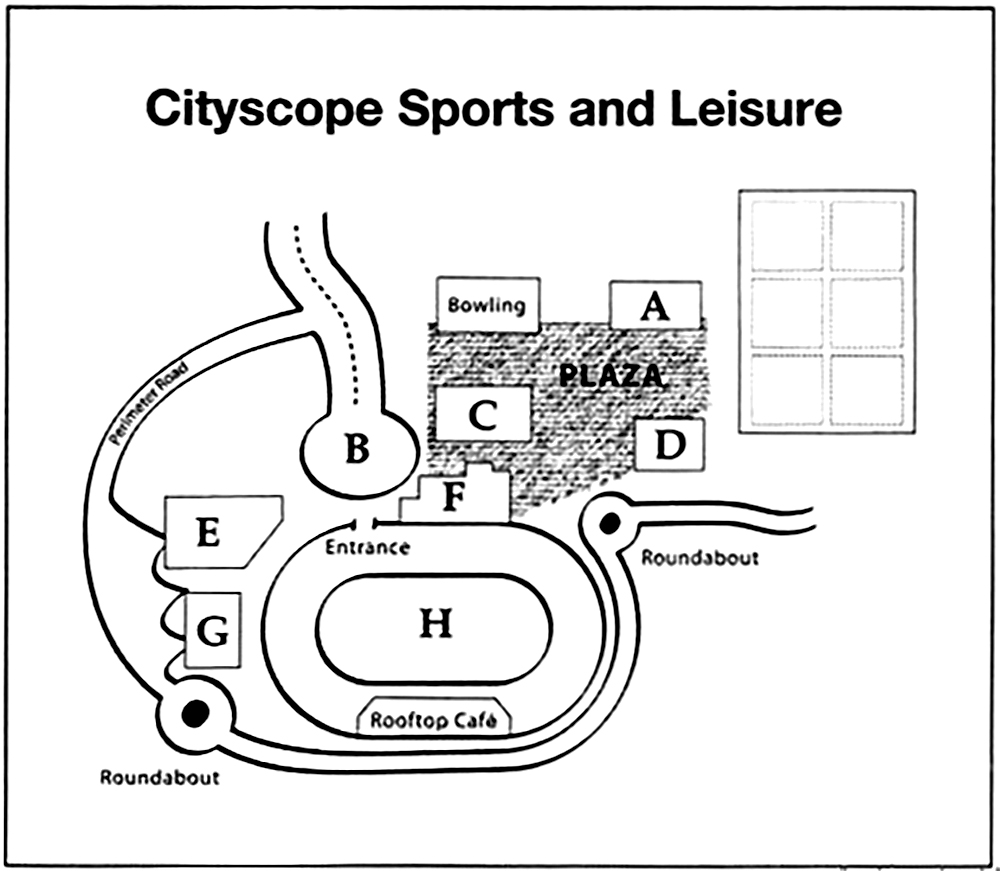
Section 2. You will hear a woman talking to a group of people who are looking round a sports and leisure centre.
First, you have some time to look at questions 11 to 14. Pause the recording for 30 seconds. Now listen and
answer questions 11 to 14.
Ladies and gentlemen, I'm very pleased to be able to welcome you to Cityscope, our lovely modern sports and
leisure facility. I've brought you up to the rooftop café on top of the stadium so that you can enjoy the view
while I explain briefly what we have here and point out to you the major features of the site. Then we'll go
round and have a look at ground level.
We're extremely proud of this new facility. You see, when the project was first discussed, we expected that a
multinational company would give us half our funding and the central government grant would make up most of the
rest with a smaller contribution from local business. Well, we'd got quite far into the planning stage when the
multinational pulled out and both central and local government decided they couldn't afford anything.
So we ended up with a beautiful project, a small amount of sponsorship promised by local organisations and
nothing else. We thought we'd never build it, but at the last moment we had an amazing donation of several
million pounds from a national transport company. And that got us going again and we managed to get all the rest
from local fundraising.
There's hardly a street in the city that hasn't made its contribution one way or another, so there's a true
sense of local ownership here. So, this is what we got. We wanted a new stadium because the 1950s football
stadium is on the other side of town and is shortly due to be pulled down and built over.
This site was the old airport with some playing fields on one side of it and a few buildings from the 1930s when
the airfield first opened. So, we were able to plan a new stadium with plenty of room for all the things people
wanted. The playing fields have been upgraded and refenced so they are now a set of top-quality outdoor pitches
for amateur football, hockey and so on.
We have both sports and other entertainments here. We want to encourage all kinds of people onto the site and
hope some of them may come to use the cinema or the cafe and end up trying the fitness centre. These are all
grouped together.
The cafe is in the original 1930s passenger hall and the architects have managed to retain some of the elegant
style of the building. The other buildings, like the control tower, which would have made a great feature, and
the aircraft hangars, which we had hoped might house the fitness centre, were unfortunately not structurally
sound enough to preserve. So, everything else is newly built, opened in 2010.
Before you hear the rest of the talk, you have some time to look at questions 15 to 20. Pause the recording for
30 seconds. Now listen and answer questions 15 to 20.
Right, now if you'd like to gather a little closer to the window, I'll point out the various buildings. We're at
the highest point of the stadium here in the rooftop cafe, on the opposite side to the main entrance doors. On
our left, you can see two buildings just beyond the end of the stadium.
The closest one is the business centre, used for meetings and conferences and so on, which provides a good
source of revenue for the upkeep of the sports facilities. And next to the business centre, the bigger building
is the hotel, which is rented from us by an independent company. As you see, they are served by the perimeter
road, which runs round three quarters of the site.
Now, coming round to the front of the building, immediately in front of the entrance, that circular open space
at the end of the road is the transport hub. From here, there are buses and a monorail link to the free car
park, about ten minutes from here, but you can't see that. There's also a large secure cycle park, oh, and
disabled parking of course.
People find it's very convenient and it keeps the site virtually car-free. OK, now if you look as far as you can
over to the right, beyond the buildings, you can see our outdoor pitches, which I mentioned earlier. Between the
pitches and the entrance is a little kind of pedestrian plaza.
Are you with me? OK, with the cinema in the building furthest away from us, next to the pitches, then there's
the ten-pin bowling between the cinema and the road. Near the far end of the perimeter road and between the mini
roundabout and the pitches, there's our fitness centre, with all kinds of equipment and a small pool, and
changing rooms for teams using the pitches. Then, joined onto the stadium next to the entrance, is a range of
small shops, which all specialise in sports equipment, clothes, shoes.
They sell toys and so on as well. All that sort of thing. They seem to be doing well.
As you see, the service road goes right round, but we keep the traffic and the pedestrians well apart, so it's
all very relaxed round the plaza, popular with families. And just in front of the bowling is our lovely
restaurant. You can see it from here.
It's that building on the plaza between us and the bowling. It's open all day and in the evenings. There's quite
a queue there at weekends, I'm pleased to say.
So, now you've got the layout, we can go and have a closer look at everything. That is the end of section 2. You
now have half a minute to check your answers.
SECTION 3
You will hear a conversation between two students and their professor discussing an essay.
First, you have some time to look at questions 21 to 26. Now listen carefully and answer questions 21 to 26. For
next week, I'd like you to undertake a piece of research in preparation for writing your final essay.
In order to gain top marks, you must include a range of primary, secondary and tertiary sources. Are there any
questions? Yes, Professor, I have a question. We haven't yet covered how to undertake this sort of research in
much depth, and I'm a little unsure of what you want us to do.
In telling us to include primary sources, do you mean you want us to design and distribute a questionnaire,
analysing the results? You could design a questionnaire, but you'll soon find that distributing a questionnaire
on such a large scale is somewhat troublesome. We couldn't possibly expect you to do it effectively as an
individual university student, without the necessary resources. No, ideally, I would like you to form one or two
focus groups and interview them.
This will provide you with a more qualitative approach. If your strengths lie in mathematics, please by all
means take a more quantitative approach, but this will be more strenuous and time-consuming and isn't entirely
necessary for the purpose of this study. Professor, you haven't told us what our project is about.
Do we get to choose our own topic based on the previous study? No, I'm afraid not. This will be a strictly
Australian study. However, you can choose which angle you'd like to take, so long as it remains within the realm
of anthropology.
Does anyone have any questions specifically about the formation of the focus groups? I'd had several emails
about this, and I'd like to address it now. My study is related to growing up in Australia and the question of
nature versus nurture. I've gathered more than 200 schoolchildren who would be happy to participate in a focus
group.
Do you think we'll need to include that many participants in a focus group? Blimey, Douglas, well done for
finding that many willing children, but you definitely don't need that many for the study you're going to
undertake. I'd say you need no more than five children per group and no more than three groups, so 15 children
altogether. You definitely need to control the group size in order to generate a meaningful dialogue.
OK, if it's useful, I'll try and do it. I appreciate your enthusiasm for the project, but there are plenty of
different ways to gather data, and I'm sure that if you look hard enough, you'll find someone who has conducted
almost the exact same research in the past. My advice for you is don't be too ambitious and try to include as
much information about various people or sectors.
For those who haven't ever collected original data before, what do you suggest we do? I would suggest that you
read accounts from other people who have undertaken such research to see what advice they can give. I would also
encourage you to read Chapter 8 in the course textbook, which should give you a good introduction to collecting
data. Moreover, you should try to practise using the data table provided in your course handbook.
By now, you should have read at least six or seven books giving quite detailed instruction on how to go about
collecting data. Professor, I don't know about everyone else, but I'm having trouble reading the books. I had a
really big assignment for another course and I've been spending all my time on that.
Jane, have you read all the books the professor mentioned? Well, my trouble is getting hold of the books. I've
been to the library several times, but all the books are out. Sounds like you should have started borrowing
books a bit earlier.
Yes, I should have, but I got several ones from my friend a couple of days ago. I just skimmed through them and
don't remember a lot of the information. Before you hear the rest of the conversation, you have some time to
look at questions 27 to 30.
Now listen and answer questions 27 to 30. But now let's look at these things. We'll need to start thinking about
which ones we'll definitely want to do for the project.
OK, the first one here is the final report. If you like, we can work together on the research and data
collection side of the project, and doing the final write-up. Cool, that sounds good.
I'm not sure how much I'd be able to contribute considering I haven't had a chance to read the course material,
but I should be able to prepare some sheets and a list of questions that can be used during the focus group
sessions. That sounds appropriate. I think so too.
Do you think we'll need to write a letter to send to the participants, telling them the time and place for the
interviews? Positive. I can take care of that. Well, that's great.
I should also include a document for them to sign, saying that they're happy to be voice-recorded. Oh yes, of
course. I forgot about the transcript.
That'll likely be a big job, so let's do half each. I'll do one of the groups, and you can do the other, OK?
Sounds like a plan. That is the end of section 3. You now have half a minute to check your answers.
Now turn to section 4.
SECTION 4
You will hear a talk on the research of the graphical symbol. First, you have some time to look at questions 31
to 40. Now listen carefully and answer questions 31 to 40.
Good morning, everyone. Today I'm going to talk about the graphical symbol. A graphic symbol is a written symbol
that is used to represent speech, such as those used in the Greek alphabet.
The term graphic symbol encompasses anything from the logographs used in Egyptian hieroglyphic writing to
ancient Chinese pictograms. Early symbols were based on pictographs and ideograms before they were developed
into logographic writing systems. These systems are still in use in some non-literate cultures in Africa, the
Americas, and Oceania.
Indeed, elements of pictography are still found in modern Chinese characters, and it is often an interesting
exercise to trace the origins of some Chinese characters. Pictographs remain in common commercial use today as
signs, instructions, or statistical diagrams. Road signs and public toilet signs, and even flat-pack assembly
instructions utilizing pictures, are considered pictographic.
Ancient graphic writing systems provide researchers with a wealth of knowledge about past civilizations. In
1799, one of the most important historical discoveries was made by accident when members of Napoleon's
expedition to Egypt found a stone in Rosetta that exhibited three different scripts. The stone, now known as the
Rosetta Stone, was studied in significant depth by scholars and was first deciphered by Frenchman Jean-François
Champollion in 1822.
He was able to correctly determine the phonetic values of the symbols, and later research has confirmed his
findings. In many of these symbols, lines are used to portray a multitude of meanings, and knowledge and
understanding of these lines holds the key to comprehension of graphic writing systems. A key moment in the
history of communication was the invention of the camera obscura, or camera.
Although the concept can be traced back to the 5th century BC Chinese philosopher Mo Ti, the first photographic
image was ultimately created in 1826 by Joseph Nicephore Niceph. Photography, as it was later known, enables
researchers to piece together and better understand history. Today, photography forms a huge part of everyday
life, and most publications contain a vast number of photographs.
Photography is used in advertising and is now becoming a way to increase awareness of existing world issues. For
example, animal welfare charities are increasingly using photography to advertise animals that are at high risk
of endangerment. Charity workers are sometimes flown to far-flung locations to document the suffering endured by
high-risk animals in an attempt to raise human awareness of their consumption activities and how they impact
others.
One recent high-profile campaign was undertaken by attaching a camera to the foot of a bird in order to obtain
photographs of the animals in their natural habitats and understand how often they come into contact with human
waste. A soon-to-be-released documentary about the suffering of animals on Midway Island shows the full extent
to which human consumption is harming animals thousands of miles away from us. As photography continues to
progress, with the use of drones now becoming somewhat commonplace, we should expect more and more objects to be
included in the future, expanding the horizon of photography ever further.
Indeed, the downward pressure on traditional media prices means that media companies are being forced to get
creative on how to make a profit. Many have found that the answer to this lies in advertising, and companies are
now willing to devote a large portion of their budgets to advertising in newspapers. By the same token,
marketing has become an essential part of a company's business model, often meaning the success or failure of a
company.
As a result, much time and money has been pumped into the development of effective branding, with attractive
packaging playing a large role in this. However, many governments are now seen to be cracking down on marketing
and packaging in an attempt to protect consumers from being misled. In particular, tobacco companies are now
subject to ever-increasing regulation.
For example, in the United Kingdom, legislation is soon to pass preventing any form of branding or
differentiation on cigarette packaging in efforts to curb the harmful effects of smoking. Finally, one must not
forget the fundamental role that graphic writing systems have had to play in mathematics. Graphs, icons and
diagrams often form the very basis of these branches of academia.
Indeed, one needs to look no further than chemistry's periodic table to see a perfect example of graphic writing
systems in use today. That is the end of Section 4. You now have half a minute to check your answers. That is
the end of the listening test.anies would like to invest a lot to advertise in newspapers and other media
outlets, recognizing the power of visual communication. Designing appealing packaging is used as a way of
effective branding, drawing on the principles established by ancient graphical symbols.
Graphic writing systems are of great importance in the subject of mathematics, as they demonstrate how humans
have developed systems of representation and communication throughout history. The study of these symbols helps
us understand not only how ancient people communicated, but also how they thought about and organized
information.
That is the end of section 4. You now have half a minute to check your answers. That is the end of the listening
test. In the IELTS test, you will now have 10 minutes to transfer your answers to the answer sheet.